

Quick Summary
Plauti works well for Salesforce data quality, but it may feel like more than you need if routing is your main focus. Here are our top three Plauti alternatives for teams looking for more flexible assignment.
| Pick | Best For | Pricing | G2 Rating |
| Kubaru | Focused, maintainable routing without a wider data suite | $20/user/mo, every feature included | 4.9/5 |
| Distribution Engine | Deep native routing for mid-market teams | $20 to $55/user/mo (tiered) | 4.9/5 |
| Traction Complete | Replacing Plauti’s full data suite with routing plus data quality | Quote-based (about $65/user/mo) | 4.7/5 |
Why look for a Plauti alternative?
When routing becomes one of the busiest parts of your Salesforce workflow, it’s worth asking whether you need a full data quality platform or a tool that’s focused on assignment. Plauti is well known for its Salesforce data quality tools, with routing included as part of the wider platform. For many Salesforce teams, having both in one place can be a practical choice.
As your team grows, though, you may find yourself spending far more time managing routing than data quality. That’s often when it starts to make sense to look at platforms built specifically for assignment. This guide compares eight Plauti alternatives to help you find the right fit.
Why Listen to Us?
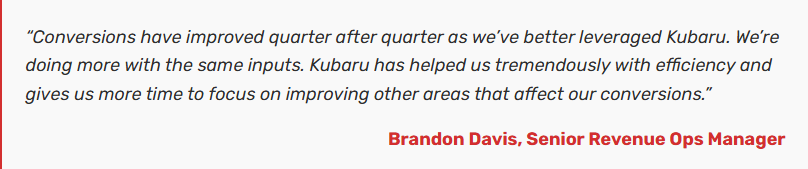
Kubaru helps more than 300 Salesforce teams automate lead, case, and record routing, including companies like Genesys, Paylocity, and AXA Health. We’ve seen what works, where teams run into friction, and which features make the biggest difference as routing grows more complex.
Where Plauti Falls Short
Plauti has a 4.5-star rating on G2, but the reviews also point to a few areas that can become frustrating when routing is your main priority.
Routing Is Not the Main Focus
Plauti Assign sits alongside the platform’s data-quality modules like Verify and Deduplicate. If your main need is assignment, you are buying into and learning a wider platform than the job requires. Plauti’s own reviews on G2 lean heavily toward deduplication, which is where most users spend their time.
Pricing Is Hard to Estimate
Plauti does not publish its pricing, so you’ll need to contact sales before you know what the platform will cost. Third-party pricing estimates range from a few thousand dollars per year to much higher for larger implementations, making it difficult to compare options or build an early budget.
Setup Can Take Time
Plauti Assign is flexible, but reviewers on G2 repeatedly note that the number of options is a lot to take in at first, and the Match Groups and Match Rules model carries a real learning curve. If your goal is to get routing up and running quickly, that extra complexity may not be worth the tradeoff.
Top 8 Plauti Alternatives
| Tool | Pricing | G2 Rating | Best For |
| Kubaru | $20/user/mo, all features | 4.9/5 | Focused routing without a data suite |
| Distribution Engine | $20 to $55/user/mo (tiered) | 4.9/5 | Deep native routing, mid-market |
| Q-Assign | From $38/user/mo (territories extra) | 230+ AppExchange reviews | Service and support assignment |
| PowerRouter | $15 to $35/user/mo (annual) | Too few reviews to rate | Visual, no-code routing on a budget |
| LeanData | Quote-based (about $39 to $59/user/mo) | 4.6/5 | Enterprise orchestration |
| Chili Piper | $45/user/mo plus platform fees | 4.6/5 | Routing paired with scheduling |
| Sweep | Quote-based (about $1,000 to $2,000/mo) | 4.9/5 | RevOps workspace with routing |
| Traction Complete | Quote-based (about $65/user/mo) | 4.7/5 | Replacing Plauti’s full data suite |
1. Kubaru
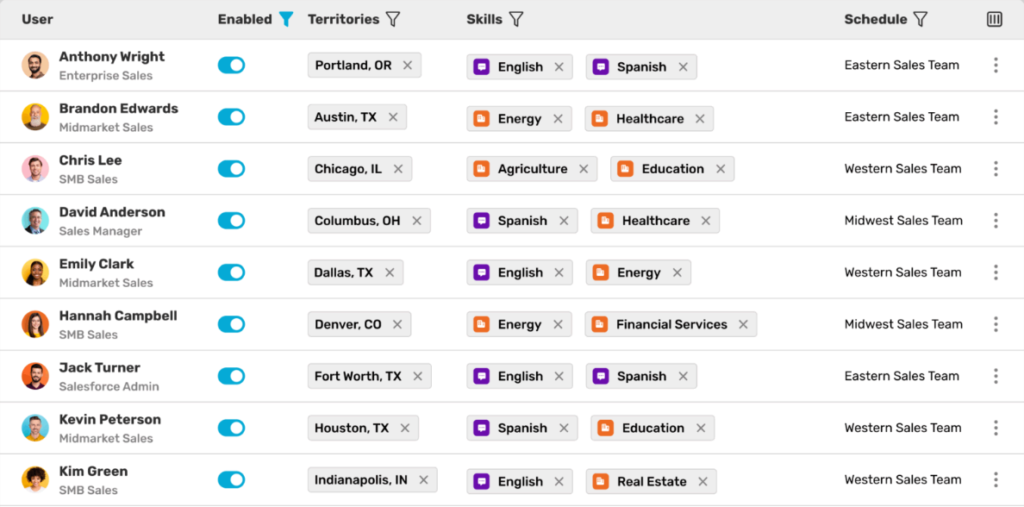
Kubaru is a Salesforce-native routing platform built specifically for assignment automation. Instead of combining routing with a wider data quality suite, it focuses on helping Sales Ops and RevOps teams get records to the right person as quickly as possible.
Because our platform runs entirely inside Salesforce, there’s no separate platform to manage. Sales and support teams can build routing rules without relying on custom Apex or waiting for an admin to make routine updates. That makes it a good fit for teams whose routing needs continue to evolve as they grow.
Key features
- Instant assignment for any Salesforce object, from leads and cases to accounts, opportunities, and custom objects
- Rules that look at skills, territory, workload, and who is free to take the next record
- Round robin and weighted round robin, so busier reps can take a lighter share
- Automatic reassignment of records that go unworked, so nothing sits and goes cold
- A shark tank where reps claim records from a shared pool during busy spells
- Duplicate matching that sends related records to the same rep
- Updates by email, mobile, desktop, Slack, and Microsoft Teams the moment a record is assigned
- Clear logs that show how each record was routed and why
Pricing
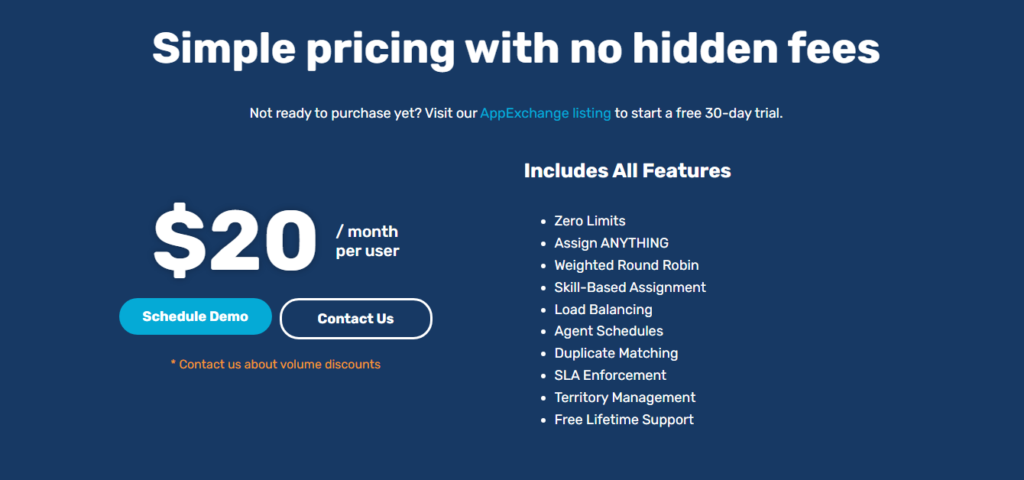
Kubaru is $20 per user each month, and every feature is included at that price, with nothing held back as a paid add-on. Onboarding and support are free for as long as you are a customer, and the whole product is free to try for 30 days on the AppExchange.
Pros
- One flat price with every routing feature included, so the budget is easy to plan
- Runs fully inside Salesforce, so your data never leaves your own environment
- Quick to set up, and your team can change rules in minutes
- Free onboarding and support included for every customer
Cons
- Built for assignment, so it does not clean or verify data the way Plauti’s other modules do
- Paid only, though the free trial lets you test it first
Best for
Teams whose main job is routing, and who want something quick to run without paying for a wider data platform.
G2 rating
4.9 out of 5 on G2, plus more than 140 five-star reviews on the Salesforce AppExchange.
2. Distribution Engine (NC Squared)
Distribution Engine is a Salesforce-native routing platform from NC Squared. It supports routing for any Salesforce object and includes advanced assignment features, making it one of the closest alternatives to Plauti Assign for teams that want to stay entirely within Salesforce.
Compare more options in our guide to the best Distribution Engine alternatives.
Key Features
- Route any Salesforce object using a single routing platform.
- Support round robin, weighted assignment, and workload-aware routing.
- Manage territories through an interactive map.
- Test routing rules against real Salesforce data before publishing changes.
- Track assignments with built-in reporting and automatic reassignment.
Pricing
Distribution Engine offers three annual plans with a five-user minimum. Starter costs $20 per user each month, Advanced is $35, and Unlimited is $55. Premier Support is available for an additional 20%.
Pros
- Strong routing capabilities across Salesforce objects.
- Published pricing makes it easier to compare plans.
- G2 reviewers often highlight the onboarding experience and customer support.
Cons
- Several routing features are reserved for higher-priced plans.
- Some reviewers say complex assignment scenarios can take extra work to configure.
- Large routing jobs may still run into Salesforce processing limits.
Best For
Mid-sized Salesforce teams that want advanced routing features and prefer a Salesforce-native platform.
G2 Rating
4.9 out of 5 on G2, based on 10 reviews.
3. Q-Assign (Ortoo)
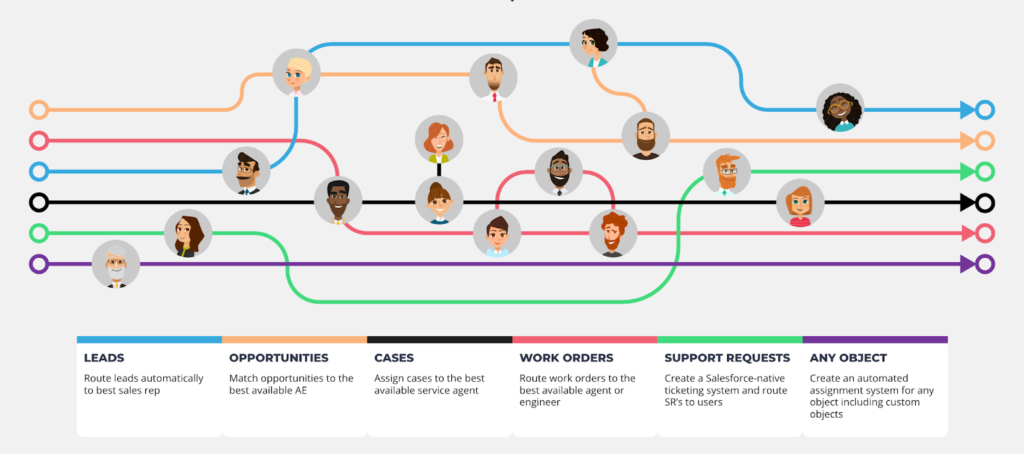
Q-Assign is a Salesforce-native routing platform from Ortoo. It’s designed for teams that manage a high volume of work and want assignment decisions to take factors like skills, availability, and workload into account.
See our guide to the best Q-Assign alternatives for a closer comparison.
Key Features
- Route any standard or custom Salesforce object.
- Match records using skills, workload, or agent availability.
- Prioritize records with AI before they’re assigned.
- Track and manage SLAs across sales and service teams.
Pricing
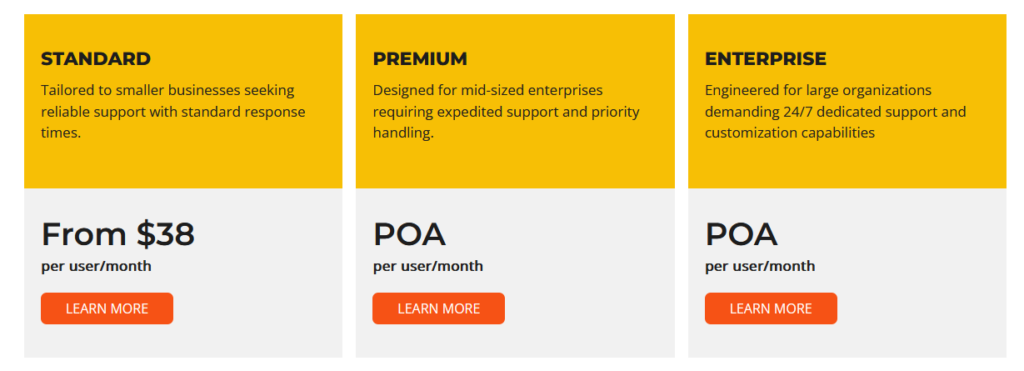
Q-Assign starts at $38 per user each month. Territory management is available as a separate add-on rather than being included in the base price.
Pros
- Well suited to high-volume sales and support teams.
- AI-powered prioritization adds another layer to assignment decisions.
- Supports flexible routing across standard and custom Salesforce objects.
Cons
- Territory management increases the overall cost.
- Higher starting price than several Salesforce-native alternatives.
- Limited public review data compared with more established routing platforms.
Best For
Sales and support teams that need attribute-based routing and AI-assisted prioritization.
G2 Rating
Not currently rated on G2.
4. PowerRouter
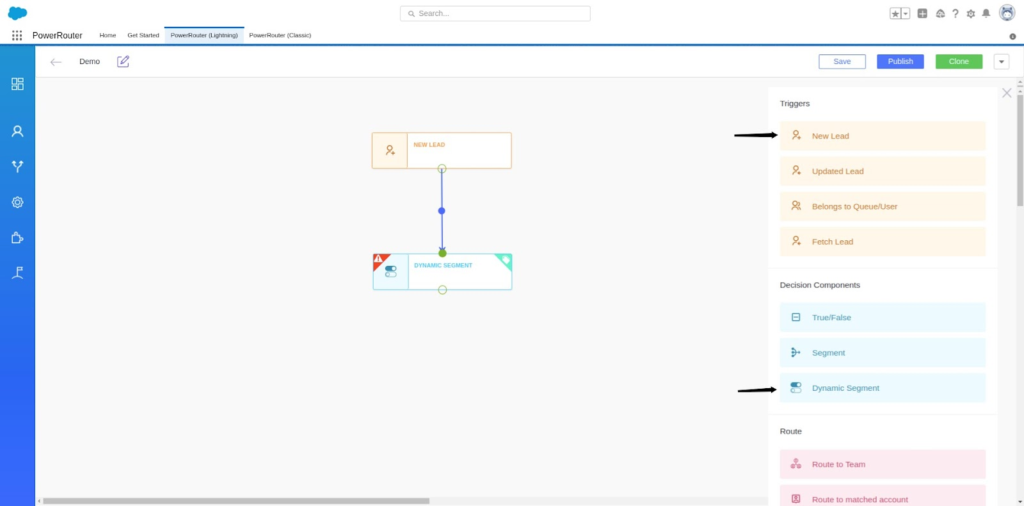
PowerRouter is a Salesforce-native routing platform built around a visual, drag-and-drop builder. It’s a good option for teams that want to create and update routing rules without writing code, while still getting useful reporting on assignment performance.
Key Features
- Build routing rules with a visual, no-code canvas.
- Match new leads to existing Salesforce accounts.
- Create fallback routing paths when a record doesn’t match the first rule.
- Track speed-to-lead by team, rep, or lead segment.
Pricing
PowerRouter offers three annual plans. Starter costs $15 per user each month, Growth is $25, and Enterprise is $35. Monthly billing is also available at a higher price. Only routing users and administrators require licenses.
Pros
- Visual builder makes routing rules easy to understand.
- Competitive starting price on annual plans.
- Licensing model can help reduce costs for larger teams.
Cons
- Some users report slower performance when working with more complex routing setups.
- Limited public review history compared with more established routing platforms.
Best For
Salesforce teams that want a visual routing builder and prefer a no-code approach.
G2 Rating
Too few G2 reviews for an overall rating.
5. LeanData
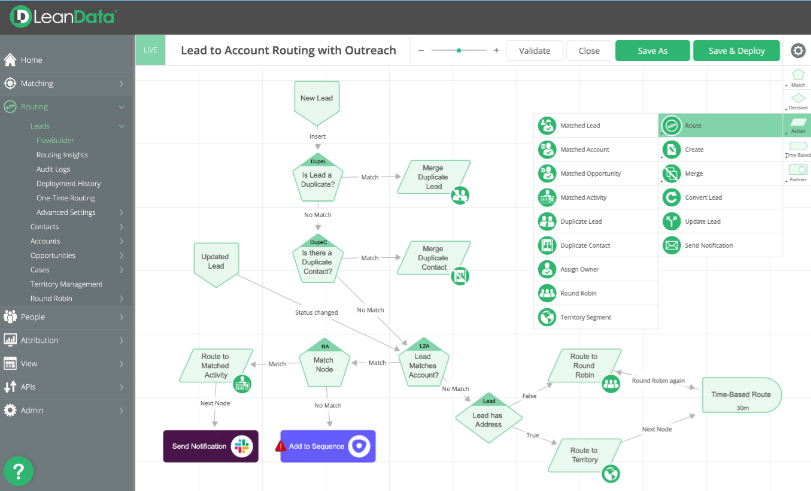
LeanData is best known for helping enterprise Salesforce teams manage lead routing as part of a larger revenue orchestration platform. Along with assignment, it includes lead-to-account matching, workflow automation, and integrations that support more complex go-to-market processes.
Key Features
- Build routing workflows with a visual FlowBuilder.
- Match leads to existing Salesforce accounts.
- Support round robin and capacity-based assignment.
- Connect with platforms such as 6sense, Outreach, Salesloft, and Slack.
Pricing
LeanData uses custom, tiered pricing and does not publish its plans. The last publicly available estimates placed pricing at roughly $39 to $59 per user each month, with implementation services typically adding another 15% to 25% of the annual license cost.
Pros
- Well suited to large Salesforce environments with complex routing needs.
- Strong lead-to-account matching capabilities.
- Broad integration ecosystem.
Cons
- Pricing requires a sales conversation and implementation can add to the overall cost.
- Setup often takes several weeks and may require admin or consultant support.
- May feel like more platform than teams need if routing is the main priority.
Best For
Enterprise RevOps teams looking for routing as part of a broader revenue orchestration platform.
G2 Rating
4.6 out of 5 on G2.
6. Chili Piper
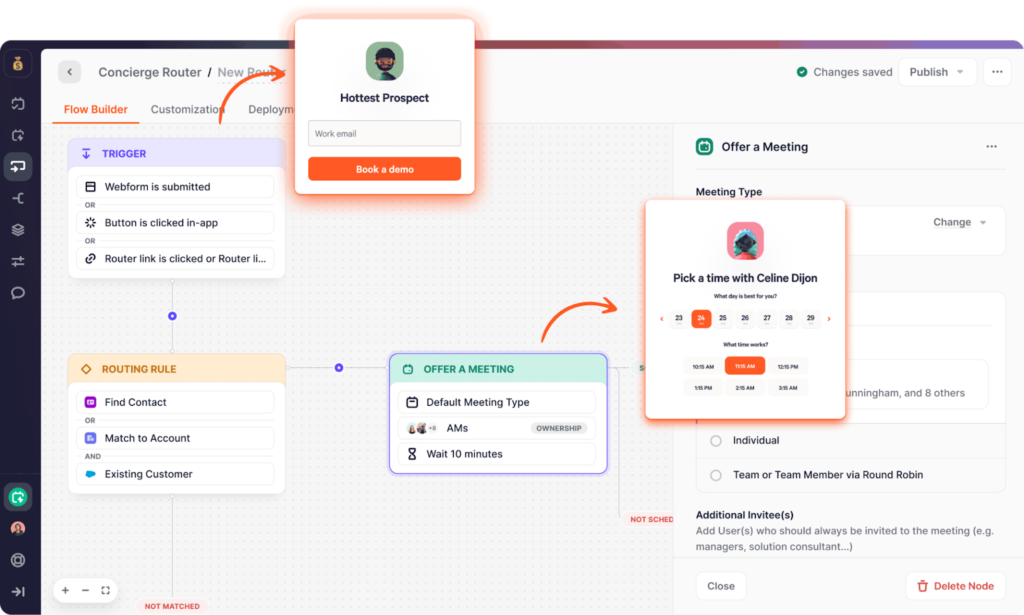
Chili Piper is a demand conversion platform that bundles routing through its Distro product with meeting scheduling and inbound web experiences. It is most relevant when you want routing and booking to work as one motion off a web form.
Read our guide on the best Chili Piper alternatives to learn more.
Key Features
- Automate lead distribution with Distro.
- Let prospects qualify and book meetings directly from web forms with Concierge.
- Schedule handoffs between SDRs and account executives.
- Support round robin assignment that stays in sync with team calendars.
Pricing
Distro starts at $45 per user each month. Platform fees range from $150 to $1,500 per month, depending on lead volume.
Pros
- Good choice for teams focused on inbound meeting conversion.
- Combines routing and scheduling in a single workflow.
Cons
- Platform fees increase the overall cost as lead volume grows.
- Teams looking only for Salesforce routing may end up paying for features they don’t need.
Best For
Inbound sales teams that want routing and meeting scheduling to work together.
G2 Rating
4.6 out of 5 on G2.
7. Sweep
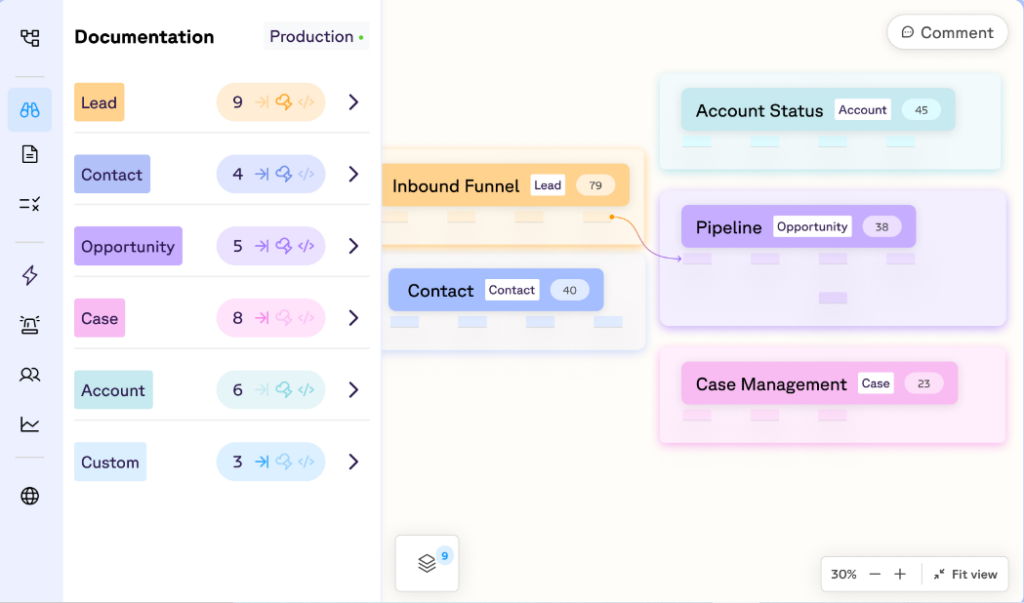
Sweep is a Salesforce platform built for RevOps teams that want to manage routing alongside automation and data quality. If you’re considering alternatives to Plauti because you also rely on deduplication, Sweep brings those capabilities together in a single visual workspace.
Key Features
- Build routing and territory rules with a visual workspace.
- Improve Salesforce data quality with built-in deduplication.
- Automate Salesforce processes and send alerts when action is needed.
- Generate documentation that maps how your Salesforce environment is configured.
Pricing
Sweep uses quote-based pricing. The Growth plan starts at around $1,000 per month, while the Scale plan costs about $2,000 per month and adds support for routing custom objects.
Pros
- Combines routing, automation, and data quality in one platform.
- Visual workspace makes Salesforce administration easier to manage.
- G2 reviewers frequently praise the customer support team.
Cons
- Platform pricing can be difficult to justify if routing is your main priority.
- Some reviewers mention limits when using Sweep automations alongside Salesforce Flow.
- Error logging is less detailed than some teams would like.
Best For
RevOps teams looking for a single platform to manage routing, automation, and Salesforce data quality.
G2 Rating
4.9 out of 5 on G2, based on 32 reviews.
8. Traction Complete
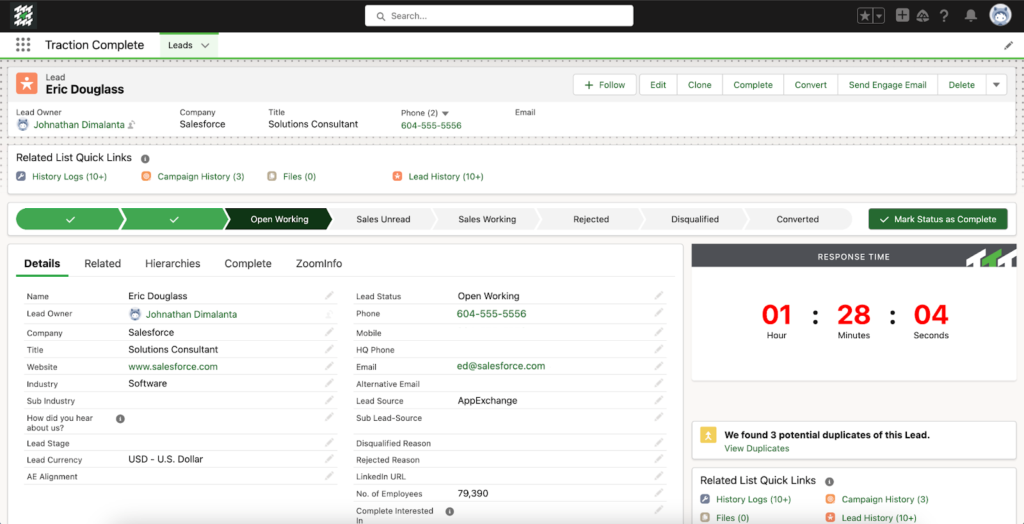
Traction Complete is a Salesforce-native RevOps platform that combines routing with data quality tools. If you’re replacing more than just Plauti Assign, it’s a close alternative because it also includes lead matching, deduplication, and account hierarchy management.
Key Features
- Route leads across standard and custom Salesforce objects.
- Match leads to existing Salesforce accounts.
- Manage parent-child account hierarchies.
- Improve data quality with deduplication and enrichment tools.
Pricing
Traction Complete uses quote-based pricing. Third-party estimates place Complete Leads at around $65 per user each month, with larger deployments costing considerably more when multiple products are included.
Pros
- Brings routing and data quality together in one Salesforce-native platform.
- Strong lead matching and account hierarchy capabilities.
- Good fit for account-based sales teams.
Cons
- Pricing is not publicly available.
- Some reviewers mention a learning curve when setting up routing.
Best For
Salesforce teams replacing Plauti’s broader platform and looking for routing alongside data quality tools.
G2 Rating
4.7 out of 5 on G2.
Ready for a Simpler Way to Manage Salesforce Routing?
If routing is the feature your team relies on every day, you shouldn’t have to pay for a much larger platform to get it. Kubaru gives you advanced Salesforce routing for $20 per user per month, with every feature included, free onboarding, and lifetime support at no extra cost.
Start your free 30-day trial on the Salesforce AppExchange, and we’ll help you get your routing set up.