

Quick Summary
Lead response time measures how fast your sales team contacts a new lead. Responding within five minutes can make leads 21x more likely to convert. This guide covers key benchmarks, the factors that slow teams down, and practical strategies (including automated routing with Kubaru) to consistently hit those targets.
Why Lead Response Time Can Make or Break Your Pipeline
How quickly sales teams respond to leads matters a lot, especially for businesses intentional about maximizing conversions. Multiple industry studies prove this.
Like the facts that:
- 30-50% of sales go to the vendor that responds first.
- Waiting just 10 minutes to respond increases the risk of losing a lead by 100x.
- Responding within 5 minutes makes leads 21x more likely to convert compared to waiting 30 minutes.
Together, these statistics highlight a clear first-responder advantage: speed directly increases your chances of winning deals, just as slow responses cost you customers and revenue.
This is why lead response time is such an important metric for revenue teams. When your reps respond as quickly as prospects expect, you significantly increase the likelihood of closing every hard-won lead.
In this article, we’ll break down what lead response time really means, the benchmarks you should aim for, and practical ways to hit those benchmarks using our Salesforce lead routing tool, Kubaru.
What Is Lead Response Time?
Lead response time is the amount of time it takes for your sales team to make the first meaningful contact with a lead after it enters your system.
The clock typically starts the moment a lead is:
- Submitted via a website form
- Passed from marketing to sales
- Captured through a chatbot or live chat
- Imported from a webinar, event, or campaign
And it stops when a sales rep takes a real, human action, like:
- Making a phone call
- Sending a personalized email
- Booking or proposing a meeting
Auto-replies and generic confirmation emails don’t count as a true response. The action must come from a human rep. For example, if a lead fills out a demo request at 10:00 AM and a sales rep calls at 10:07 AM, the lead response time is 7 minutes.
Lead response time is also commonly referred to as speed-to-lead.
Lead Response Time Benchmarks
The best-performing sales teams respond to leads within very specific time windows. The benchmark you choose can make or break your conversion rates.
1. Under 1 Minute
Responding within 60 seconds can increase conversion rates by as much as 391% compared to slower responses. This window is often referred to as the “platinum minute”—a point where speed doesn’t just meet expectations but decisively beats competitors.
2. Within 5 Minutes
This is the most widely referenced and competitive benchmark, and for good reason. Research shows that:
- Leads contacted within 5 minutes are 21x more likely to qualify than those contacted after 30 minutes.
- Responses within 5 minutes achieve a 2.6x higher close rate compared to responses made after 24 hours.
Even as buyer expectations continue to evolve, the first five minutes remain one of the strongest predictors of lead quality and engagement. For most teams, this benchmark is a realistic and effective starting point.
3. Within 30 Minutes to 1 Hour
Responding within 30–60 minutes is still far better than waiting hours or days. However, the conversion impact drops sharply after the first few minutes. Studies show that after one hour, the likelihood of qualifying a lead can fall by 10x or more compared to near-immediate contact.
Optimizing Lead Response Time Is a Massive Opportunity
Despite how important speed is, most companies still respond far too slowly—or not at all. Research shows that:
- The average B2B lead response time is 42–47 hours, nearly two days. (Source)
- In some companies, as many as 47% of leads are never contacted. (Source)
- Only 23% of companies respond within five minutes. (Source)
This gap creates a massive advantage for teams that move fast. If you can consistently hit benchmark response times, you capture the first-responder advantage—winning leads before competitors even realize they’ve received one.
Factors Affecting Lead Response Time
Lead response time is influenced by every step between a lead expressing interest and a sales rep making contact. These steps generally fall into three stages:
1. Lead Processing Time
This is the time between a lead taking an action (like filling out a form or requesting a demo) and the moment the lead is registered and enriched in a CRM like Salesforce. Processing may include verification, data enrichment, or cleanup, and any delay here directly increases overall response time.
For example, if your Salesforce intake or lead enrichment takes several hours, the first opportunity for a rep to respond is delayed—even if the rep is ready and available.
2. Lead Routing Process
Once a lead is processed, the next factor is how quickly it gets assigned to the right rep. Manual routing—or routing that doesn’t account for priority, rep skill, or territory—can leave leads sitting idle or assign them to a less-prepared rep, slowing response times.
3. Rep Availability and Workload
Even when a lead is processed and routed correctly, response time depends on whether the assigned rep can engage immediately. Overloaded reps, or those who are offline, on leave, or outside business hours, create bottlenecks that delay responses further.
Strategies to Improve Your Lead Response Time
1. Invest in Proper Lead Enrichment and Data Accuracy
Before a rep can respond effectively, lead data must be complete and accurate. Make sure each incoming lead is enriched with relevant information like company size, industry, location, or past interactions—and that these attributes are correct. You can use lead enrichment platforms like Demandbase for this.
Fast, reliable lead data ensures reps don’t waste time researching details before reaching out, enabling immediate responses and increasing conversion chances.
2. Eliminate Manual Routing
Manual lead assignment is slow, error-prone, and often causes delays that result in missed opportunities. Automated lead routing ensures leads are assigned quickly and that the best-fit rep handles each one.
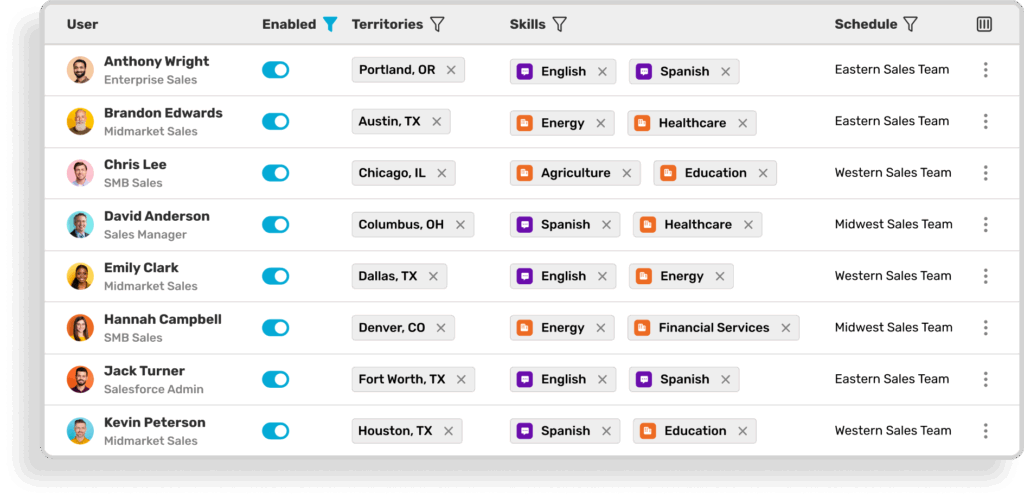
For simple sales processes, Salesforce assignment rules or Flows can handle automated routing. But for teams with multiple territories, complex products, or sophisticated GTM models, a more robust lead routing solution like Kubaru is needed.
Kubaru takes lead routing further by:
- Routing leads based on territory, skill, or location, but also based on real-time rep availability, workload, and capacity limits
- Using round robin, weighted round robin, and workload balancing to ensure fair distribution among reps
- Giving managers direct control over assignment logic without relying on developers, IT, or admins
- Routing any Salesforce object, including leads, cases, accounts, opportunities, and tasks
- Automatically reassigning leads that go unworked due to absence or overload
- Scaling seamlessly as lead volume and assignment rules grow
- Allowing unlimited assignment rules
Kubaru is also 100% native to Salesforce, meaning it respects Salesforce’s security settings and introduces no vulnerabilities.
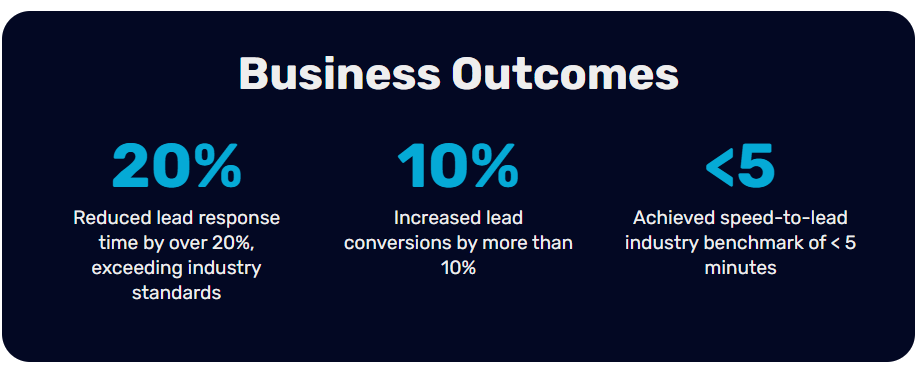
Kubaru has helped brands like Ooma, Conga, and Exclaimer achieve a lead response time of under five minutes.
3. Embrace Training and Process Standards
Even with automated routing, reps still need clear processes and proper training to act quickly and consistently. Document standard operating procedures (SOPs) for handling new leads and provide training on CRM usage and communication templates.
With clear SOPs, every rep—whether new or experienced—knows the exact steps to follow when a lead is assigned. This ensures fast, confident responses and helps your team consistently meet response-time targets.
4. Monitor and Track Response Times
Tracking performance is essential for identifying bottlenecks and measuring improvements. In Salesforce, you can monitor first response time across leads, reps, and campaigns to pinpoint where delays occur.
With Kubaru, you gain even deeper insights through detailed assignment logs for every routed lead. These logs reveal exactly what’s working and what isn’t, making your improvements data-driven and enabling proactive adjustments to maintain fast response times.
Get Ahead of Competitors With Kubaru
In sales, speed wins almost every time.
Teams that respond to leads quickly capture more opportunities, nurture stronger relationships, and prevent leads from slipping to competitors.
But consistently achieving fast lead response times requires more than just setting a target. You need to measure current response times, adopt best practices like accurate lead enrichment and automated routing, and ensure reps are trained and processes are standardized.
Salesforce assignment rules and Flows can help with much of this, especially for smaller businesses with low lead volumes and simple routing logic.
But as you scale toward mid-market and enterprise levels, you need an adaptable lead routing solution like Kubaru to maintain the fast response times you’ve worked hard to achieve.
Curious about what Kubaru can do? Start your 30-day free trial today.