














Quick Summary
The Distribution Engine vs LeanData choice hinges on how much you want your router to do. Distribution Engine stays lean, handling native assignment at a clear per-user rate. LeanData bundles matching, scheduling, and orchestration for enterprise RevOps.
Kubaru lands in between: serious routing depth at one flat, predictable price.
| Key Differentiators | Distribution Engine | LeanData | Kubaru |
|---|---|---|---|
| 100% Salesforce-native (managed package) | Yes | Yes | Yes |
| Data leaves Salesforce | No | No | No |
| Routing logic (round robin, weighted, capacity) | Yes | Yes | Yes |
| Objects routed | Leads, cases, opps, custom | Any object (Premium tier) | Any object |
| Lead-to-account matching | Included (Advanced tier) | Advanced (category-leading) | Included |
| Scope | Routing only | Orchestration + scheduling | Routing only |
| Pricing | $20 to $55/user/mo (3 tiers) | Quote-only (typically $22k+/yr) | $20/user/mo (flat) |
| Implementation | Days | 4 to 8 weeks | ~1 day |
| AppExchange Rating | 4.9/5 stars (AppExchange) | 4.9/5 stars (AppExchange) | 5/5 stars (AppExchange) |

Why Put These Two Side by Side?
Buyers often lump Distribution Engine and LeanData together, but they rarely compete head on. One is a focused routing app you can stand up in days. The other is a platform that can run a whole revenue team.
Teams usually choose between them at the exact moment a simple router starts to feel too small, or a full platform starts to feel too big.
Both answer that need from opposite ends of the lead routing spectrum. Distribution Engine is routing-first, trusted by 20,000+ users at companies like Okta and Aetna. LeanData wrote the playbook for revenue orchestration and runs at Zoom, DocuSign, and Snowflake.
Neither moves your data off-platform, since both run as managed packages.
Below, we measure the two tools across four areas: features, ease of use, native fit, and pricing. We finish with a straight recommendation, plus where Kubaru changes the math.
How Do Distribution Engine and LeanData Compare Head-to-Head?
We line the two up across the key areas that decide most deals. Each one shows where a tool pulls ahead and where it falls back.
Features and Routing
The two approach routing with very different ambitions.
Distribution Engine
Distribution Engine does one job: distribute records fairly and predictably. Round robin, weighted, and territory rules cover leads, cases, opportunities, accounts, contacts, and custom objects, and records can match on skills, lead source, or ownership of a related account.
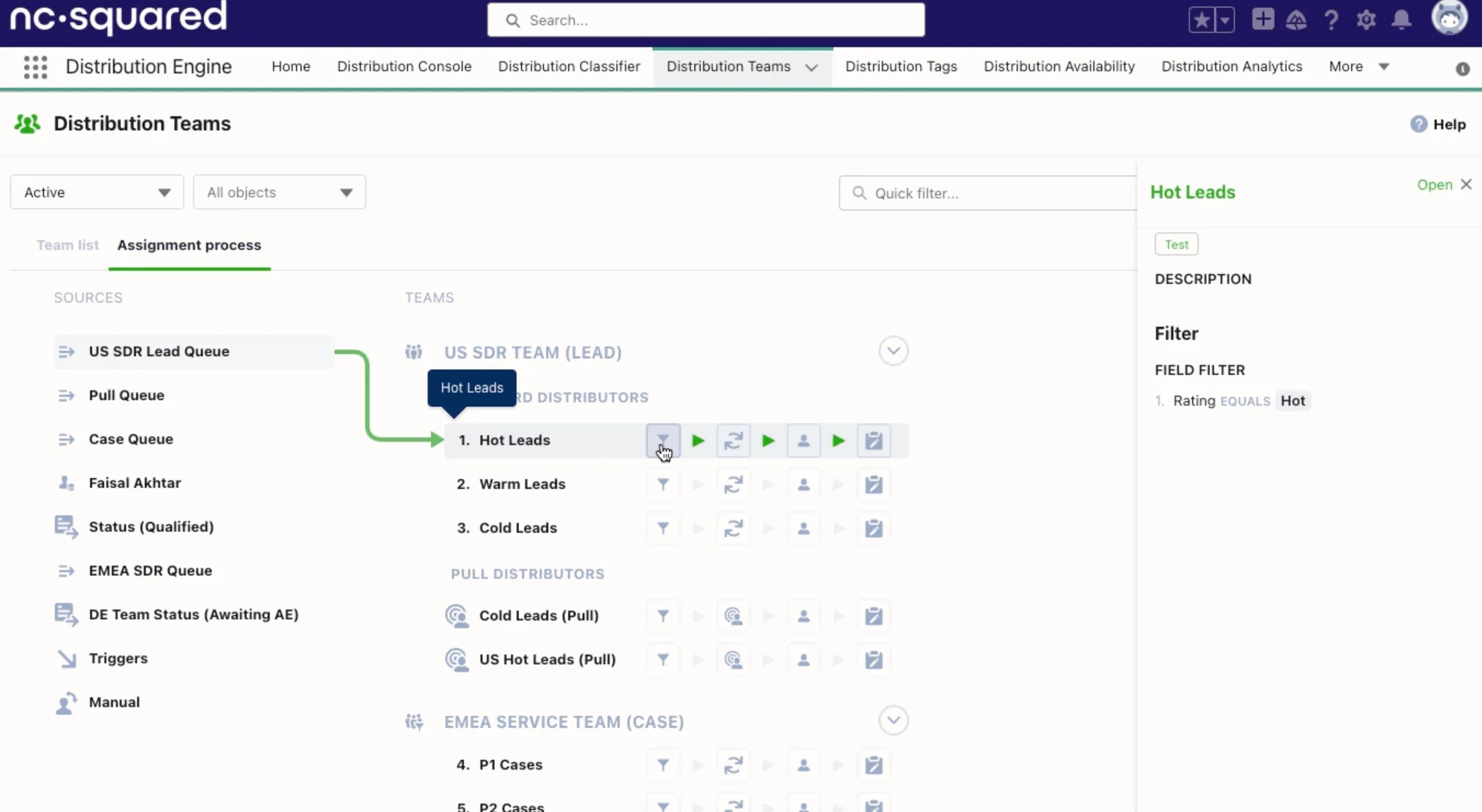
Reps stay protected from overload through volume caps, load balancing, working hours, and out-of-office cover. A lead that sits untouched past its SLA bounces to someone who will work it.
Before launch, an assignment simulator runs your rules against real data. After launch, live consoles show today's assignments and who is available. Territory routing and lead-to-account matching need the Advanced tier or higher.
LeanData
LeanData reaches well past routing into orchestration. Its drag-and-drop FlowBuilder builds branching routing graphs across leads, contacts, accounts, opportunities, cases, and custom objects, though object coverage depends on your edition. Only Premium covers every object.
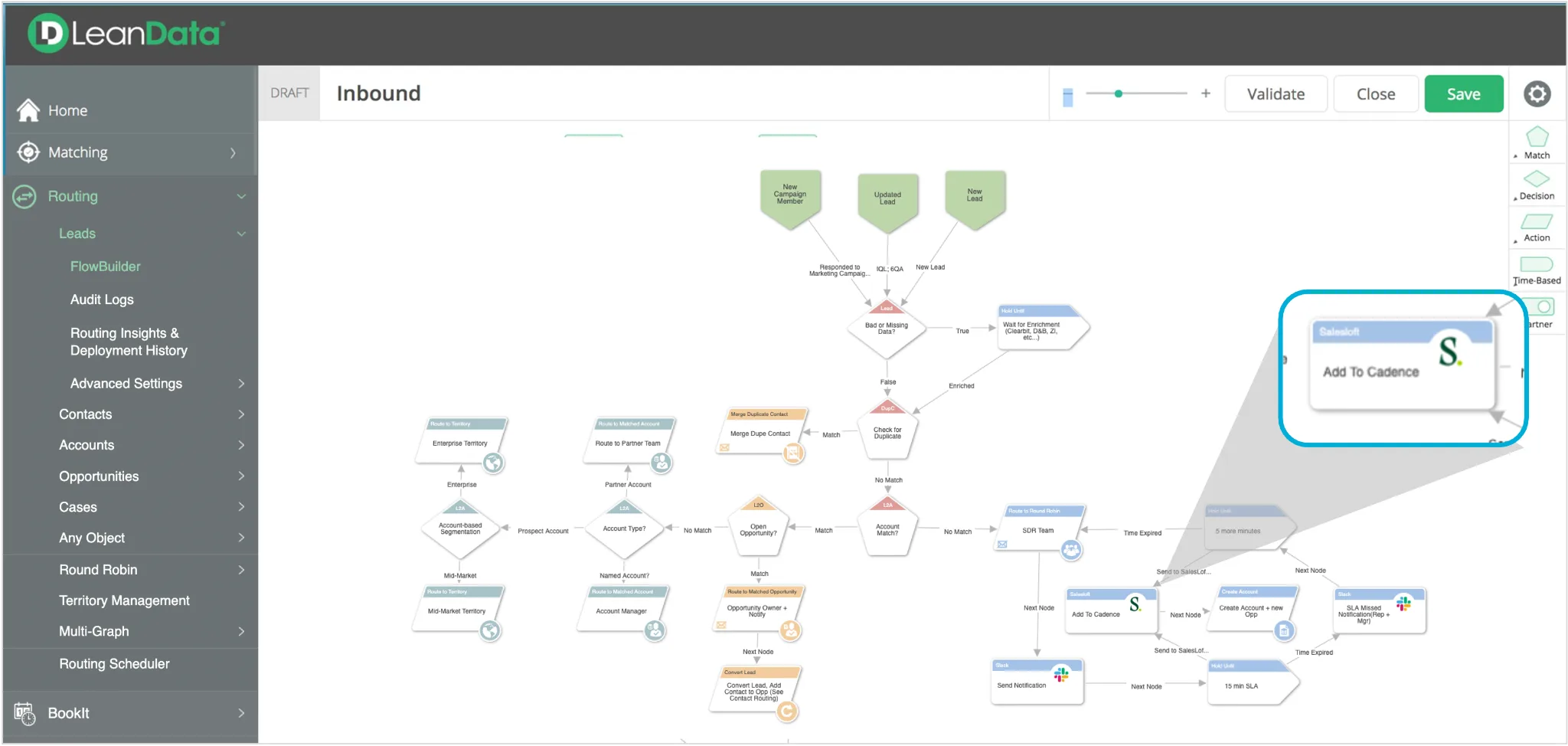
Lead-to-account matching is the marquee feature. G2 has a whole category for it, and LeanData leads that category, with fuzzy matching and duplicate merge nodes built into the same graphs.
Round robin supports conditional and time-based capping, plus working hours, holidays, and vacations. BookIt adds scheduling as a paid add-on, and a new AI Graph Summary feature documents a routing graph's logic in plain language.
Ease of Use
How much effort each tool asks for splits them cleanly.
Distribution Engine is built for RevOps, not engineers. Setup needs no Apex or Flow, and teams are typically live within days. The one prerequisite is Salesforce Enterprise Edition or higher.
LeanData asks much more. Simple matching can go live in a week, but typical rollouts run four to eight weeks with professional services involved, and implementation fees of $5,000 to $25,000 are common.
Reviewers also say the platform needs a dedicated admin or RevOps owner to build and maintain its flows. That headcount belongs in your cost math.
It circles back to breadth. Distribution Engine gets you routing fast. LeanData delivers far more, provided you can staff it and wait for it.
Salesforce-Native Fit
Both run as managed packages, so routing happens inside your org and your data stays put. Distribution Engine reports on native objects, so existing dashboards just work.
LeanData's core is equally native, with two small caveats: its new AI Graph Summary runs on a Google Gemini integration, and BookIt connects to external calendars. Core routing itself never leaves Salesforce.
Pricing Model
Cost is where the two part ways most sharply.
Distribution Engine
Distribution Engine's price list is public. Starter costs $20 per user monthly, Advanced $35, and Unlimited $55, billed annually with a five-license minimum. Advanced unlocks territory routing and lead matching; Unlimited adds API access and pull routing.
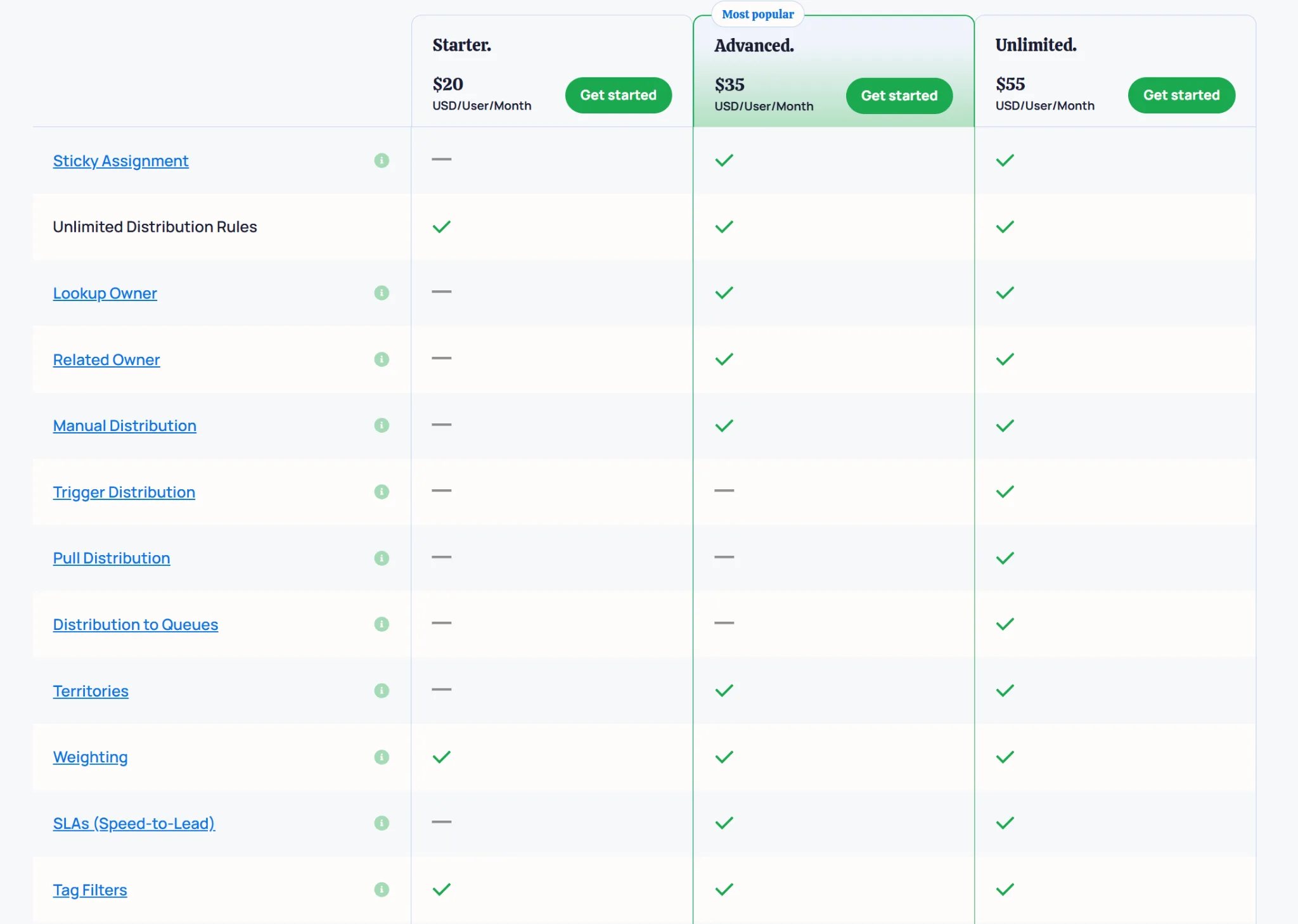
Premier Support runs about 20% extra. Forecasting stays simple because the bill follows headcount. Our Distribution Engine pricing guide runs the full numbers.
LeanData
LeanData quotes privately across Standard, Advanced, and Premium editions, priced per user. Vendr data puts the median contract at $22,722 a year, with smaller teams commonly quoted $25,000 to $50,000.
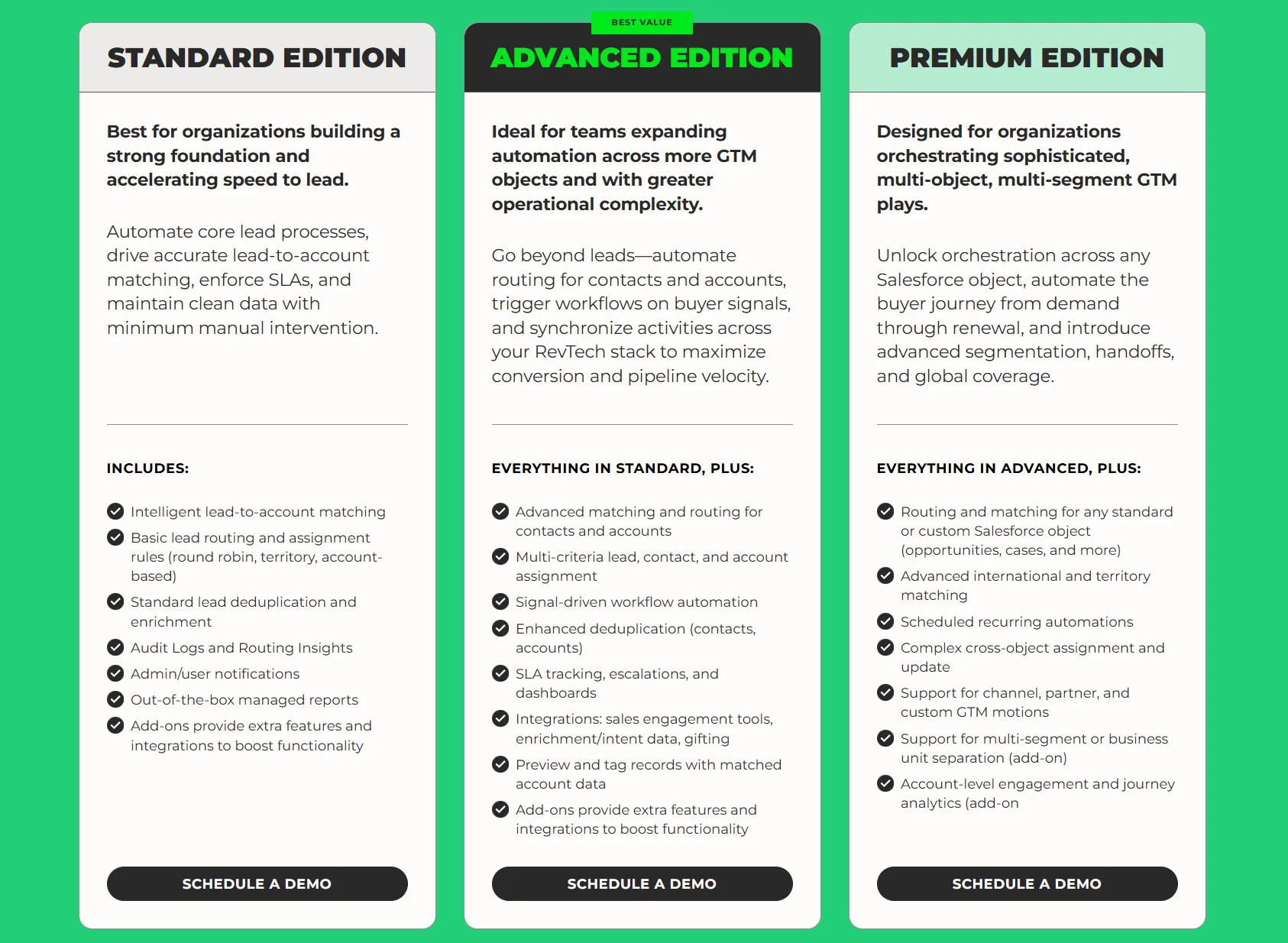
Extras stack up from there. BookIt, Multi-Graph, and NotifyPlus are paid add-ons, premium support adds 10 to 20%, and implementation is billed separately. There is no free trial, only a demo.
Renewal hikes are a frequent trigger for switching. Our LeanData pricing guide covers the reported figures.
Which Should You Pick?
Pick Distribution Engine if...
- Routing is all you need, minus the platform baggage
- Your team is mid-market and wants a quick rollout
- You prefer clear per-seat pricing over bundled extras
You give up LeanData's orchestration reach, but plenty of teams never touch it. When routing is the job, a light, efficient tool may be the perfect fit.
Pick LeanData if...
- Your GTM spans many teams and moving parts
- Precise lead-to-account matching is non-negotiable
- You want routing, scheduling, and signals under one roof
- You can fund it and staff a RevOps owner
The capability is genuine, but so is the pricing and the setup. If your team can handle the complexity and the investment, LeanData is a solid option.
Pick Kubaru if...
You want heavyweight routing without the enterprise invoice or the multi-week build. Kubaru is native to Salesforce and does one thing deeply: assignment.
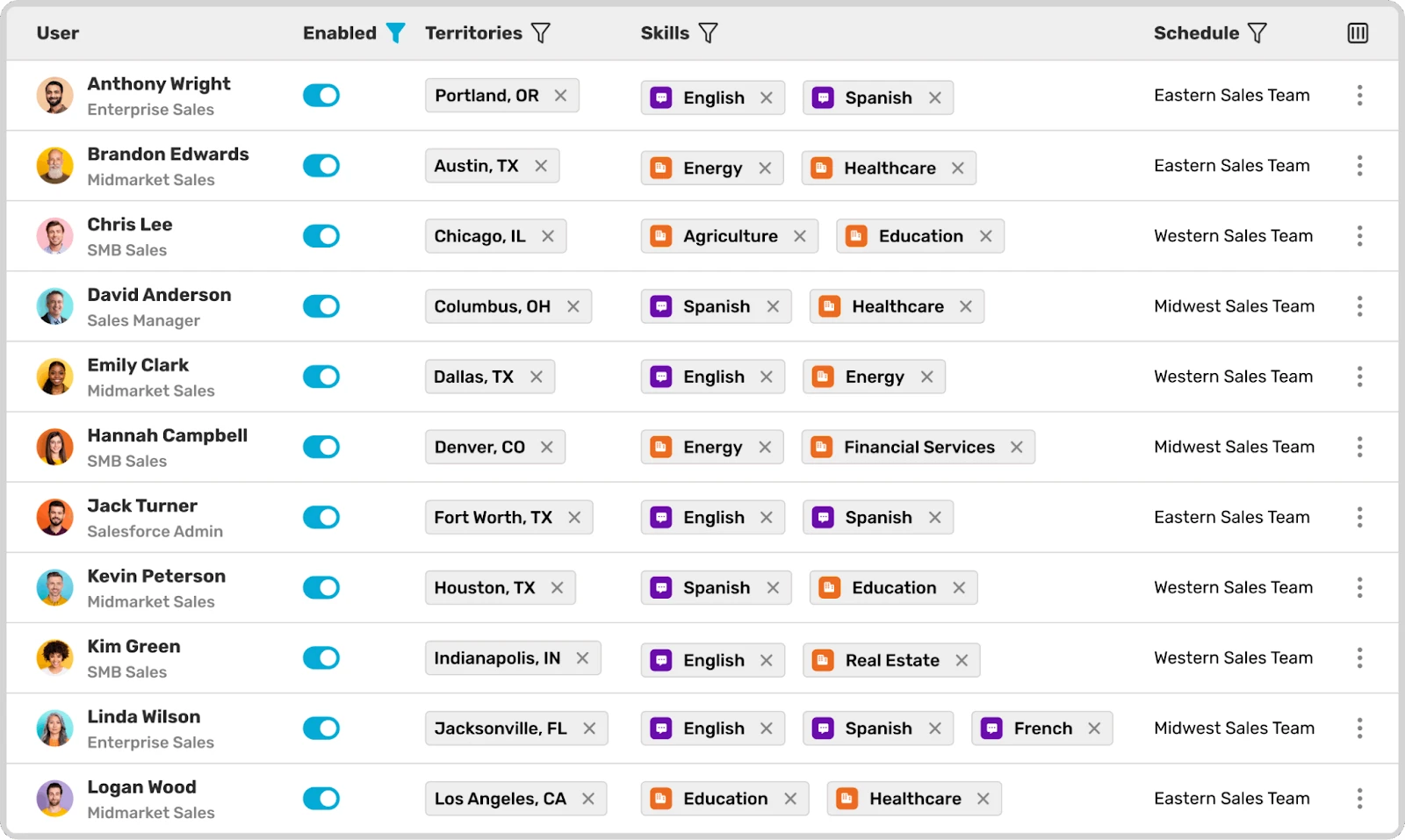
One flat rate of $20 per user each month includes everything:
- Round robin, weighted, and territory routing
- Skill-based logic with load balancing
- Automatic reassignment of stalled records
- Duplicate matching
No tiers, no bolt-on modules.
Because pricing is based on seats rather than modules or volume, budgeting stays simple as you grow. Setup takes an afternoon, and onboarding and support cost nothing.
Your own team manages the rules, with no standing RevOps hire required.
For a more detailed look at how the three stack up, check out our comparison page.
Frequently Asked Questions
Is LeanData too much for basic lead routing?
Frequently, yes. Its strengths are matching and complex orchestration. If you only need records routed, Distribution Engine or Kubaru will get there quicker and for less.
Do both tools run natively in Salesforce?
They do. Each installs as a managed package, keeping your data on-platform throughout.
Which one costs less?
Distribution Engine, as a rule. Its seat tiers run $20 to $55 per user, while LeanData contracts typically land above $20,000 a year before add-ons and implementation fees.
How quickly can each go live?
Distribution Engine can be routing within days. LeanData's typical rollout runs four to eight weeks, with professional services involved.
Is there a simpler option than both?
Kubaru routes natively for a flat $20 per user each month, with onboarding and support included and a 30-day full-feature trial.